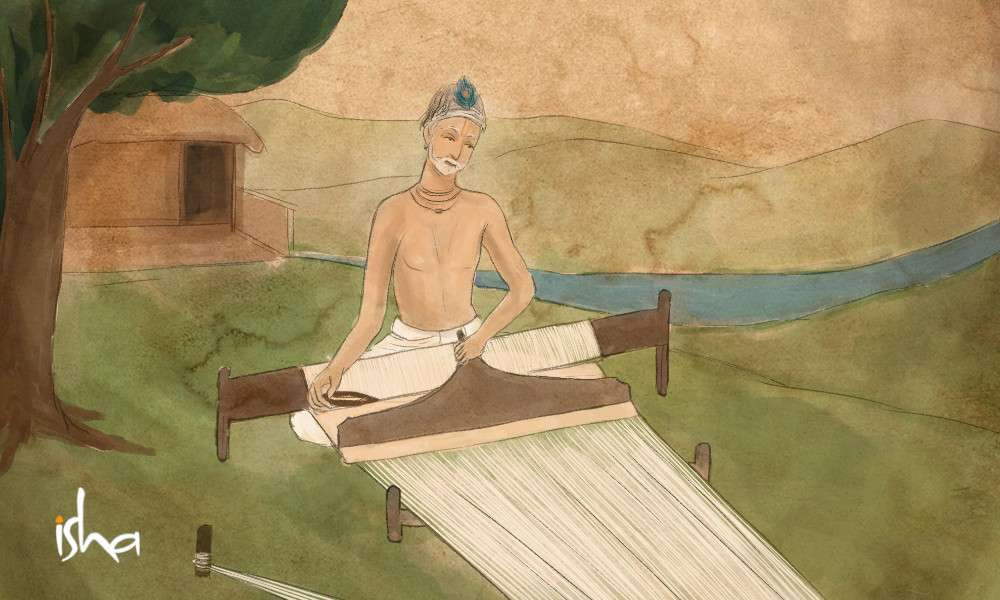
The Dance of Light and Shadow: Knowledge and Ignorance in Kabir's Wisdom
In the profound words of Kabir, "Where there is knowledge, can ignorance endure? If there be ignorance, then knowledge dies." This statement invites us to reflect on the intricate relationship between knowledge and ignorance, suggesting that the two cannot coexist harmoniously. The stakes are high; our understanding of the world and ourselves hinges on this dynamic interplay. To grasp the essence of Kabir's insight is to embark on a journey toward enlightenment, where the illumination of knowledge dispels the shadows of ignorance.
As we delve deeper into Kabir's assertion, we recognize that knowledge is not merely an accumulation of facts or information; it is a transformative force that shapes our perceptions and actions. Ignorance, on the other hand, represents a state of unawareness that can stifle growth and understanding. Kabir's words challenge us to confront the areas of our lives where ignorance may linger, urging us to cultivate knowledge as a means of liberation. This exploration is not just an intellectual exercise; it is a call to awaken to the deeper truths that reside within and around us.
The image / the metaphor
At first glance, Kabir's quote presents a stark dichotomy between knowledge and ignorance, evoking vivid imagery of light and darkness. Knowledge is akin to a radiant sun, illuminating the path ahead, while ignorance represents the shadows that obscure our vision. The verbs chosen—"endure" and "dies"—carry a weight that underscores the urgency of this relationship. Knowledge is depicted as a living entity, vibrant and dynamic, whereas ignorance is portrayed as a stagnant force that ultimately leads to decay.
In the speaker's tradition
Kabir's wisdom is deeply embedded in the bhakti tradition, which emphasizes devotion and personal experience of the divine. In this context, knowledge transcends mere intellectual understanding; it becomes a pathway to spiritual awakening. Concepts such as dharma, or righteous living, and prajna, or wisdom, resonate with Kabir's message, highlighting the importance of aligning our actions with deeper truths. The bhakti tradition encourages a heartfelt connection to the divine, suggesting that true knowledge arises from love and devotion rather than mere study.
To further illustrate this, we can turn to the teachings found in the *Guru Granth Sahib*, where the interplay of knowledge and ignorance is explored through the lens of divine love. The text emphasizes that true understanding comes from surrendering the ego and embracing humility, echoing Kabir's assertion that ignorance cannot coexist with genuine knowledge. In this light, Kabir's words serve as a reminder that the pursuit of knowledge is not solely an intellectual endeavor but a spiritual journey that requires us to confront our own limitations and biases.
Living the teaching
Consider a modern scenario where this teaching resonates: a workplace environment where misinformation and assumptions thrive. In such a setting, knowledge can be a powerful tool for fostering collaboration and understanding. When individuals commit to seeking clarity and sharing insights, they create a culture where ignorance cannot endure. This transformation requires courage and vulnerability, as it often involves challenging the status quo and addressing uncomfortable truths. By embracing knowledge, we not only enhance our professional relationships but also contribute to a more enlightened community.
In a more personal context, think about a relationship strained by misunderstandings and unspoken fears. Here, Kabir's teaching invites us to engage in open dialogue, to seek knowledge about each other's perspectives and experiences. By doing so, we illuminate the shadows of ignorance that may have clouded our connection. This practice of vulnerability and inquiry can lead to deeper intimacy and understanding, allowing love to flourish where ignorance once held sway. In both scenarios, the act of seeking knowledge becomes a transformative force, capable of healing and uniting.
A reflection
As we contemplate Kabir's profound insight, we are left with a contemplative question: In what areas of your life might ignorance be obscuring the light of knowledge? This inquiry invites us to reflect on our own experiences, encouraging us to identify the shadows that linger and the knowledge that yearns to be embraced. By engaging with this question, we open ourselves to the possibility of transformation, allowing the light of understanding to guide us toward a more enlightened existence.



Join the BrightStar Community
Stay connected with daily inspiration, event announcements, and community wisdom